Choosing an Age-Appropriate Planner
Although you can jump in
at any time to help your children organize their schedules, ideally
you’ll be building their school-age skills on top of the ones you taught
them in their preschool years. To begin, this will mean adding some
additional chores that they’re now capable of handling (see Table 1) and making sure that the method they have for keeping track of their chores is still appealing to them.
| Empty the wastebaskets. | Walk the dog. |
| Clear the dinner table. | Dust the furniture. |
| Sort the laundry. | Vacuum the carpeting. |
The continuity of a familiar
system will probably be very attractive to her. But as children grow and
progress through the middle school years, they like to transition to
more sophisticated systems. You can help keep chores from getting
ignored by looking for the right time to switch your child from a
graphic-based system to a word-based chore chart. If your family is
using a computer-based family planner, then it’s likely that your child
will prefer a computer-based chore chart. And, as your child becomes
more and more independent, you may find her wanting to take full
responsibility for her tasks by keeping track of them in a personal
electronic planner.
Of course, by the time
your child is in second or third grade, you’ll want him to be able to
keep track of his school assignments and extracurricular activities in
addition to his household chores. Student planners have come a long way
since the days of the 3- by 5-inch spiral notebook. Now they come in all
shapes and sizes, and with a wide variety of page layouts. You’ll want
to make sure that you select one that’s very user friendly.
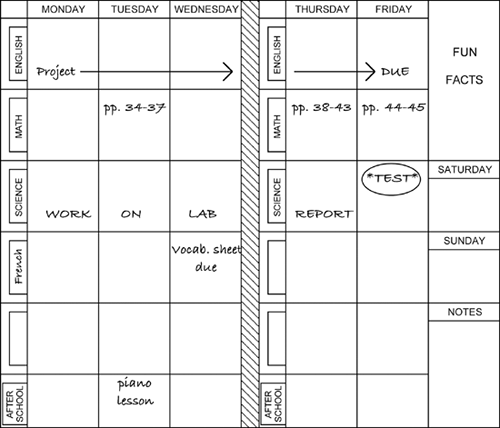
Most of the features that you’ll want the planner to have are exemplified in the format illustrated in Figure 2. Such planners offer the following benefits:
Entering
information is easy. The student can enter an assignment that will cover
a span of days by writing it in once and drawing an arrow or by writing
it in across the entire time span. (Some other formats would require
that the assignment be rewritten in a separate space for each day.)caution
It
allows for customization. Although the standard subjects are
preprinted, blanks are provided for the student to write in other
subjects specific to his course of study.A
lot of information can be assimilated very quickly. By looking down a
column, the student can see everything that is due on a given day. By
looking across a row, the student can see all assignments for a certain
subject for the entire week.There
is a “hook.” A section on each page containing fun facts or a cartoon
gives the student an enjoyable reason for opening the planner.
Figure 2. A planner with subjects down the side and days across the top lets
the student enter information with minimum effort and review the day’s
or week’s schedule at a glance.
Although planners with
this format are frequently sold as “middle school” planners, there is
no reason that they won’t work for elementary school children, and savvy
high schoolers have been known to seek them out rather than deal with
“high school” planners that have a more linear layout.
Children these
days get comfortable using electronic equipment—computers, cell phones,
and so on—at a very young age. You may find that even your elementary
school child wants to use a digital scheduler instead of a paper
planner. If he seems able to handle the information without the aid of a
more visually based paper planner, then you may want to get him an
electronic planner designed specifically for children or possibly even
an entry-level adult PDA. Just make sure that he is allowed to enter
assignments directly into his digital device while he’s at school;
otherwise, he’s sure to forget some vital information that he needs to
enter into his planner.
tip
If your child really
wants to use an electronic planner but seems to be having trouble
keeping track of things, see whether teaching her how to set the alarm
function to give her audio reminders will help.
As a final thought,
keep in mind that your child’s schedule may look great on paper or an
electronic screen, but it will still fall apart if your child has to
spend much time looking for misplaced schoolwork. Your student will want
a simple system for keeping school papers organized at school, at home,
and in between. You’ll want to help your student set up a system that
keeps work separated by subject and requires a minimal amount of paper
shuffling (see Figure 3).
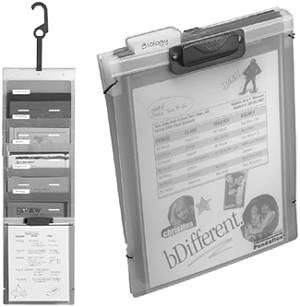
Figure 3. This student locker file with removable pockets hangs inside a
locker or on a door (left) and folds up into its own self-contained
carrying case (right).
INCLUDING HOMESCHOOLING IN YOUR SCHEDULE

Homeschooling
adds layers of complexity to the family’s schedule. But it’s really
just a matter of making a commitment to the homeschooling lifestyle and
then following the same principles of scheduling that we’ve talked about
throughout this book, making sure that you allocate time for
preparation, teaching, and following up.
No
two homeschooling programs will be exactly alike, but you’ll need to
incorporate certain steps into your family’s planner to keep your
schedule running smoothly:
If
both parents in your household work, or you have a single-parent
household, then homeschooling may require some major rescheduling of
your life, including staggering work schedules, self-employment, job
sharing, flex time, or telecommuting.
Homeschooling also requires a little more attention to some other aspects of the family’s schedule:
Scheduling time to take care of yourself as an adult, to offset the extra time you’ll be spending for and with your children.
Ensuring
that your family schedule clearly distinguishes between school life and
home life. Children need to be able to get away from studies. And
sometimes they need you to be a parent, not a teacher.