The 3rd-century Aurelian
walls are still largely intact and served as the defence of the city for
1,600 years until Italian Unification was achieved in 1870. After that,
the walls were pierced in several places so that traffic could bypass
the old gates and the modern city quickly sprawled far and wide in every
direction. Although it’s undeniable that Rome’s most dazzling sights
are contained within the walls, venturing outside them can have
spectacular rewards. Ancient roads and even an entire ancient town, as
well as some of Rome’s oldest churches, the mystical catacombs, and even
Benito Mussolini’s pretentious contributions to modern architecture are
all must-sees if you can draw yourself away from the city centre.
The Aurelian WallThis ancient wall was begun by Emperor Aurelian |
|
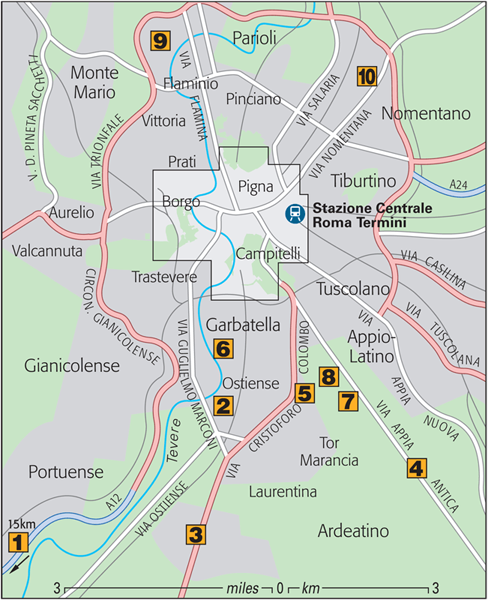
Sights
Ostia Antica
Ancient Rome’s trading heart has a wealth of fascinating ruins that evoke the city’s earliest days .
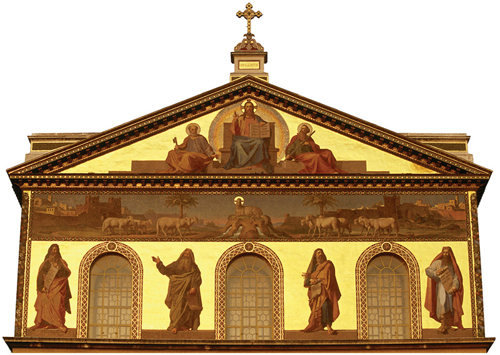
San Paolo fuori le Mura
Rome’s
second largest church has had a history of violent ups and downs. It
was built by Constantine in the 4th century, over the spot where St Paul
was buried, and for about 400 years it was the largest church in
Europe, until it was sacked by the Saracens in 846. It was rebuilt and
fortified, but its position outside the walls left it mostly ignored
until the mid-11th century, when it underwent a renewal. Then came the
1823 fire, which led to the reworking we see today.Via Ostiense 184
Metro Basilica S Paolo
Open 7am–7pm daily
Free

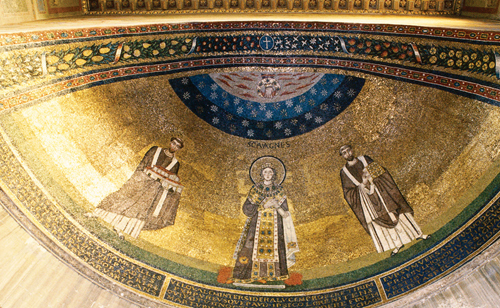
Apse mosaic, Sant’Agnese fuori le Mura

Façade, San Paolo fuori le Mura
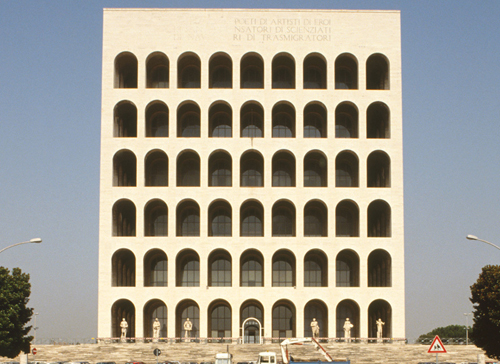
EUR
Built
by Mussolini as a showcase to the world of the ideal Fascist
metropolis, the EUR (l’Esposizione Universale di Roma) is disturbing to
many visitors. The critic Robert Hughes described the so-called Square
Colosseum as “the most frightening building in the world”, yet the
aesthetic inspired many postwar architects. Aside from the hard-edged
architecture, there’s a park with a lake, and a visit to the Museo della
Civiltà Romana is instructive.Metro EUR Palasport and EUR Fermi

Square Colosseum, EUR
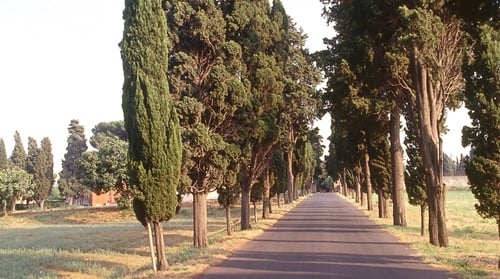
Via Appia Antica
“The
Queen of Roads” was completed in 312 BC by Appius Claudius, also the
architect of Rome’s first aqueduct. The most pastoral part begins at the
circular Tomb of Cecilia Metella, which was made into a fortification
in the Middle Ages. Starting here, you’ll see more tombs and fragments
of tombs, as well as grazing sheep and the private gates to fabulous
modern-day villas. As you walk along, look to the east to see the arches
of an ancient aqueduct marching towards the city .Buses 118, 218

Via Appia Antica
Catacombs of Domitilla
This
is the largest catacomb network in Rome. Many of the tombs from the 1st
and 2nd centuries have no Christian connection; burial of this sort was
practised by several religious sects. The chambers have frescoes of
both Classical and Christian scenes, including one of the earliest
images of Christ as the Good Shepherd.Via delle Sette Chiese 282
Buses 118, 218, 660, 760
Open Feb–Dec: 9am–noon, 2–5pm Wed–Mon (until 5:30pm in summer)
Adm €6.00
Montemartini Art Centre
Rome’s very first power station has been transformed into a remarkable showcase for Greek and Roman statues – parts of the Musei Capitolini
collection
that, until now, were kept in storage. The effect is
extraordinary, playing the monolithic might of modern technology off
against the noble, human vulnerability of these ancient masterpieces.Via Ostiense 106
Metro Piramide, Garbatella
Open 9am–7pm Tue–Sun
Adm
DA
Catacombs of San Sebastiano
Underground
cemeteries outside the city walls were created in accordance with laws
at the time, not a response to suppression (it was thought ghosts of the
dead could interfere with the living). However, the remains of saints
Peter and Paul may have been moved here, further away from the centre,
during one of the city’s periods of persecution. There are also several
4th-century mausoleums, some with exquisite frescoes.Via Appia Antica 136
Buses 118, 218
Open mid-Dec–mid-Nov: 9am–noon, 2–5pm Mon–Sat (until 5:30pm in summer)
Adm
Catacombs of San Callisto
Rome’s first official Christian cemetery, on
four levels, features some rooms decorated with stucco and frescoes,
and special crypts to early popes and saints that you can also visit.
The rooms and connecting passageways were hewn out of relatively soft
volcanic tufa. The niches, called loculi, were designed to hold two or three bodies.Via Appia Antica 110
Buses 118, 218
Open Mar–28 Jan: 9am–noon, 2– 5pm Thu–Tue (until 5:30pm in summer)
Adm
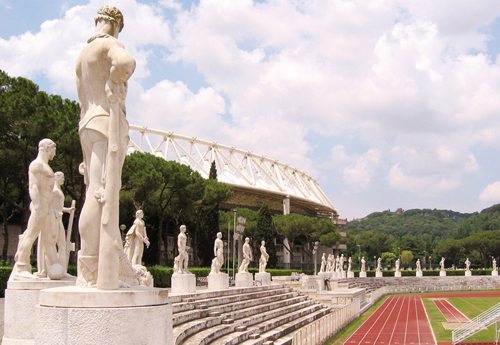
Foro Italico and Stadio dei Marmi
Originally
called the Foro Mussolini, the name was understandably changed in the
late 1940s, even though the 16-m (55-ft) obelisk still shouts out
“Mussolini Dux” (“Mussolini the Leader”). In imitation of every mad
Roman emperor, there was even supposed to have been a 75-m (250-ft)
statue of Il Duce posing as Hercules. The sculptures of the Stadio dei
Marmi, 60 colossal nude young Fascist athletes, are worth a look.Viale del Foro Italico
Bus 280

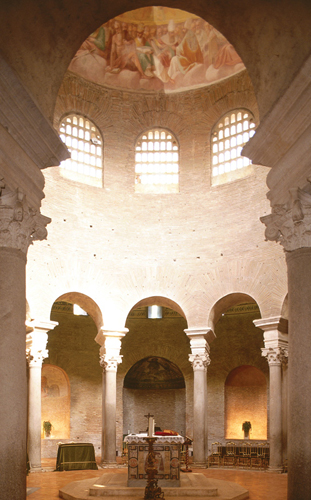
Sant’Agnese fuori le Mura and Santa Costanza
These
4th-century gems are located in the same Early Christian complex. Both
are decorated with sublime mosaic work, the former depicting the
martyred St Agnes as she appeared in a vision eight days after her
death. The ambulatory around the circular Santa Costanza has truly
delightful, richly detailed scenes of an ancient Roman grape harvest.Via Nomentana 349
Buses 36, 60, 62, 84, 90
Open 7:30am–noon Mon–Sat, 4–7:30pm Tue–Sun
Free
DA

Santa Costanza