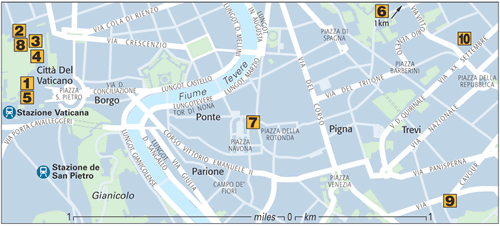
Rome’s Top 10 : Artistic Masterpieces


  1. Caravaggio’s Deposition

    Caravaggio strove to outdo Michelangelo’s Pietà
    by making his Mary old and tired. Rather than a slender slip of a
    Christ, Caravaggio’s muscular Jesus is so heavy (emphasized by a
    diagonal composition) that Nicodemus struggles with his legs and John’s
    grasp opens Christ’s wound.

  2. Raphael’s Transfiguration

    Raphael’s
    towering masterpiece and his final work was found, almost finished, in
    his studio when he died. It is the pinnacle of his talent as a
    synthesist, mixing Perugino’s clarity, Michelangelo’s colour palette and
    twisting figures, and Leonardo’s composition .

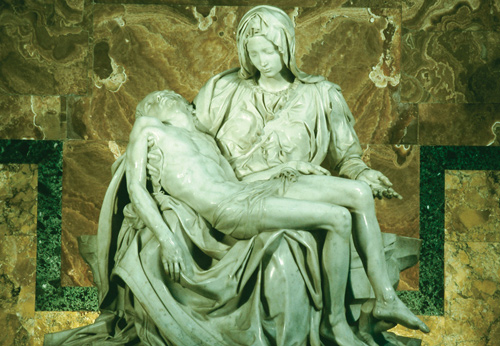
  3. Michelangelo’s Pietà

    The
    Renaissance is known for naturalism, but Michelangelo warped this for
    artistic effect. Here, Mary is too young, her dead son, achingly thin
    and small, laid across her voluminous lap. Hearing the work being
    attributed to better known sculptors, the artist crept into the chapel
    of St Peter’s one night and carved his name in the band across the
    Virgin’s chest .


    Michelangelo’s Pietà

  4. Raphael’s School of Athens

    When
    Raphael first cast his contemporary artists as Classical thinkers in
    this imaginary setting, one was missing. After he saw the Sistine
    ceiling Michelangelo was painting down the hall, Raphael added the
    troubled genius, sulking on the steps, as Heraclitus .

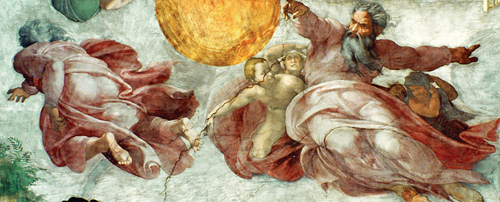
  5. Michelangelo’s Sistine Chapel

    Although
    he considered himself a sculptor first, Michelangelo managed to turn
    this almost flat ceiling into a soaring vault peopled with Old Testament
    prophets and ignudi (nude men). He did it virtually alone, firing all of his assistants save one to help him grind pigments .


    Ceiling, Sistine Chapel

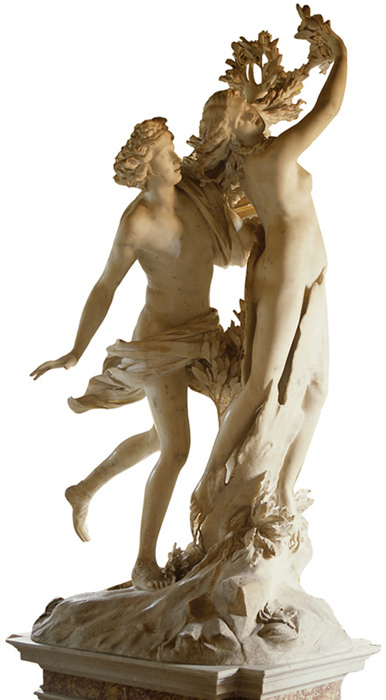
  6. Bernini’s Apollo and Daphne

    Rarely
    has marble captured flowing, almost liquid movement so gracefully.
    Bernini freezes time, wind-blown hair and cloak, in the instant the
    fleeing nymph is wrapped in bark and leaves, transformed into a laurel
    by her sympathetic river god father .


  7. Caravaggio’s Calling of St Matthew

    Caravaggio uses strong chiaroscuro
    techniques here. As a naturalistic shaft of light spills from Christ to
    his chosen chronicler, St Matthew, Caravaggio captures the precise
    moment of Matthew’s conversion from tax collector to Evangelist .

  8. Leonardo da Vinci’s St Jerome

    Barely
    sketched out, yet compelling for its anatomical precision and
    compositional experimentation. Jerome forms a spiral that starts in the
    mountains, runs across the cave entrance and lion’s curve, up the
    saint’s outstretched right arm, then wraps along his left arm and hand
    into the centre .
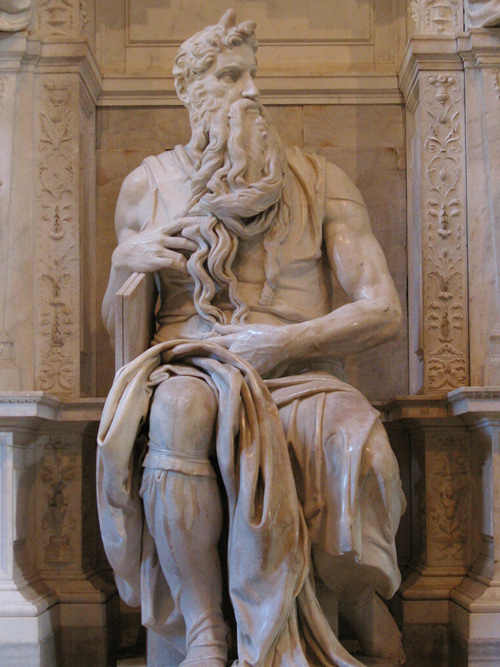
  9. Michelangelo’s Moses

    This
    wall monument is a pale shadow of the elaborate tomb for Julius II that
    Michelangelo first envisaged and for which he carved this figure. Some
    claim there is a self-portrait hidden in the flowing beard. Moses is
    currently undergoing a long restoration but remains visible .


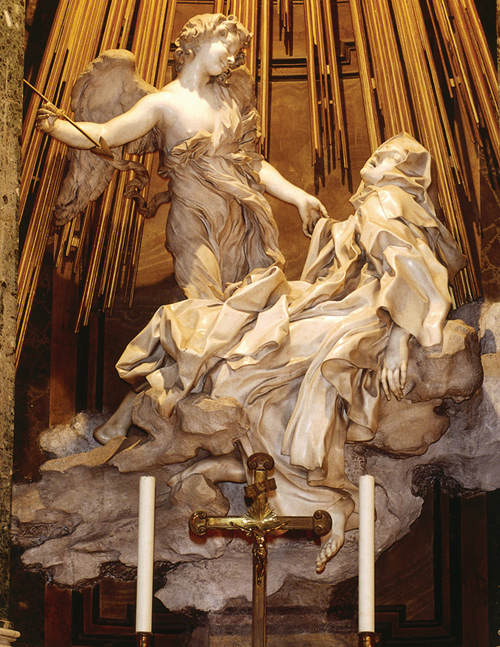
  10. Bernini’s Ecstasy of St Teresa

    The
    saint here is being pierced by a smirking angel’s lance, and is Bernini
    at his theatrical best. He sets this religious ecstasy on a stage
    flanked by opera boxes from which members of the commissioning Cornaro
    family look on .