Capitoline Hill was ancient Rome’s religious heart,
and is now home to a magnificent museum. A gently stepped grade, the
Cordonata leads you up the hill and provides an unforgettably theatrical
experience, just as Michelangelo planned it in the 16th century. At the
top you notice the outstretched hand of Emperor Marcus Aurelius, as he
dispenses peace from astride his horse. The sides of the star-shaped
piazza are graced by twin palaces that contain some of Rome’s greatest
treasures. The collections in the Palazzo Nuovo, detailed below, and in
the Palazzo dei Conservatori (see Palazzo dei Conservatori Exhibits) were inaugurated in 1471 with a donation of bronzes by Pope Sixtus IV, and have been judiciously added to ever since.
Piazza del Campidoglio 06 8205 9127 Open 9am–8pm Tue–Sun
|
The Palazzo Nuovo, on the
left as you enter the piazza, contains mostly restored ancient
sculpture. The finest pieces are on the upper floor. Then take the
stairs down to the underpass that leads to the Palazzo dei Conservatori
(see Palazzo dei Conservatori Exhibits).
The courtyard displays ancient marble fragments. The next floor up has
16th- and 17th-century decorations and Classical statuary. On the top
floor are Renaissance and Baroque paintings. |


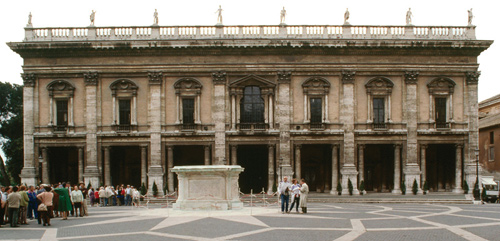
Façade, Palazzo dei Conservatori
The café behind the Palazzo dei Conservatori has a wonderful terrace with a spectacular panorama of the city. |
|
Part of the
underground passage between the museums is the Tabularium, ancient
Rome’s Hall of Records, from which you can get unusual views of the
Forum. |
|
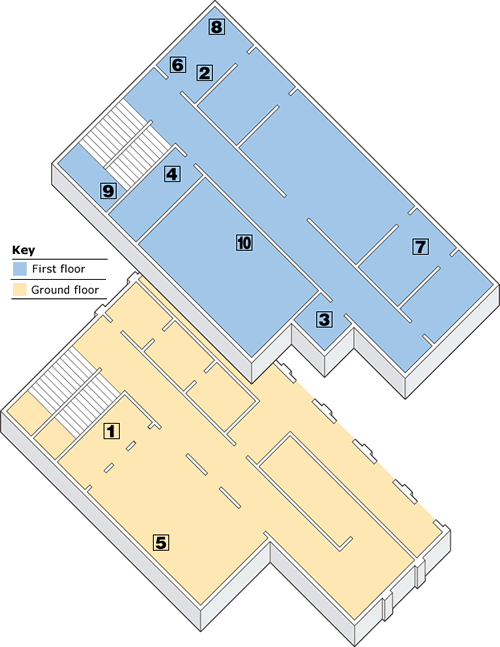
Top 10 Features
Hall of the Emperors
The
hall contains several portraits of the emperors and empresses of the
Imperial Age. Among them is a bust of the brutal ruler Caracalla from
the 3rd-century AD.
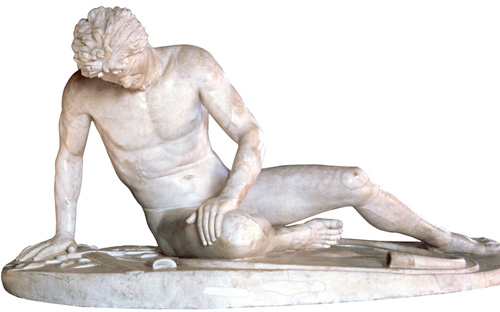
Dying Gaul
The
collection’s most renowned piece conveys great pathos. It is probably a
1st-century AD Roman copy of a Hellenistic bronze from the 3rd century
BC.

Capitoline Venus
The
shimmering goddess of love gets a room of her own. This fine
1st-century BC copy of a Praxiteles’ Aphrodite from the 4th century BC
shows her risen voluptuously from her bath, attempting to cover herself,
as if reacting to someone’s arrival.
Mosaic of the Doves
Originally the centrepiece of a floor decoration in Hadrian’s Villa, this jewel-like composition uses tiny marble and glass chips (tesserae) to achieve a sense of texture and volume.
Marforio
This hirsute reclining giant was originally a river god, and is believed to come from the Forum of Augustus . A Renaissance sculptor added the attributes of the god Ocean and placed him here, as overseer of this courtyard fountain.
Resting Satyr
Used
to adorn an ancient grove or fountain, this young mythological creature
is a copy of a 4th-century BC original by Praxiteles. His pointed ears,
panther-skin cape and flute are attributes of the nature-god Pan. The
statue inspired Nathaniel Hawthorne’s novel The Marble Faun .
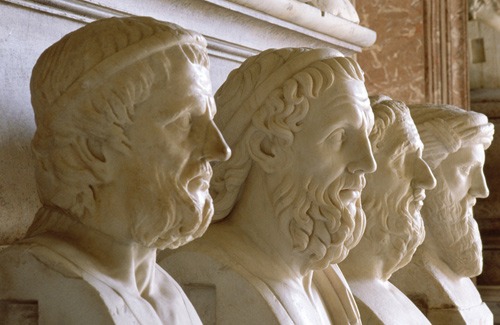
Hall of the Philosophers
Roman
copies of idealized Greek portrait busts of the greatest Hellenic poets
and thinkers fill this room, including the blind epic poet Homer.

Cupid and Psyche
The
god of love embracing the personification of the soul, the two lovers
are eternally united. This Roman copy of a Hellenistic original has
inspired many sentimental variations.
Mosaic of the Masks
This
floor decoration of two Greek theatre masks is probably from the
2nd-century AD. The use of perspective, light and shadow is highly
skilled, employing small squares of coloured marble to create dramatic
effects.
Drunken Old Woman
This copy of a Hellenistic original from the 3rd-century BC is from a series of sculptures depicting the wages of vice.