Features of St Peter’s Basilica
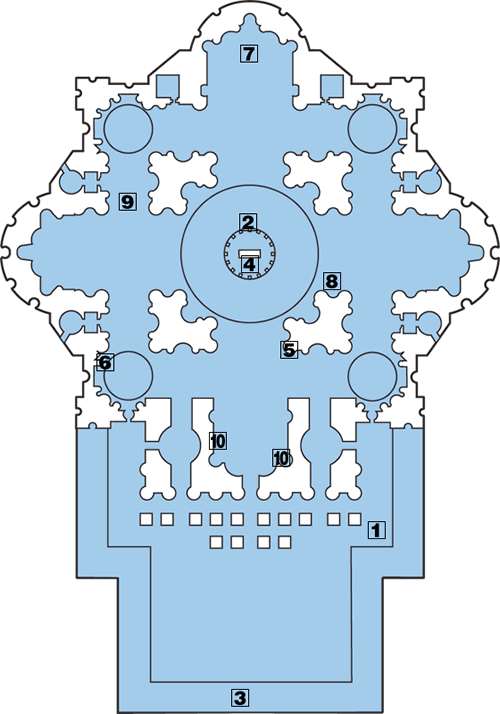
Plan of St Peter’s Basilica
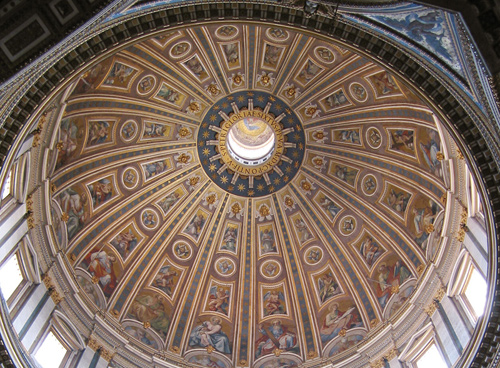
The Dome
When
Michelangelo designed a dome to span St Peter’s massive transept, he
made it 42 m (138 ft) in diameter, in deference to the Pantheon’s 43.3-m
(142-ft) dome. You can ride an elevator much of the way, but must still
navigate the final 330 stairs between the dome’s inner and outer shell
to the 132-m-high (435-ft) lantern and sweeping vistas across the city.

The Dome
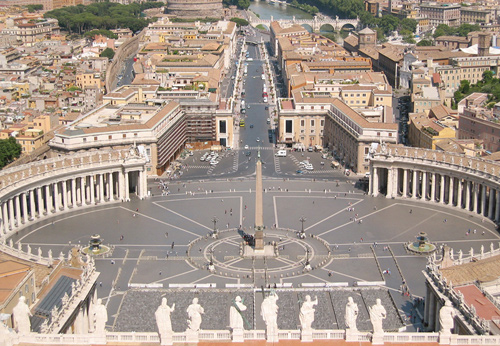
Piazza San Pietro
Bernini’s
remarkable semi-elliptical colonnades transformed the basilica’s
approach into a pair of welcoming arms embracing the faithful.
Sadly, the full effect of entering the square from a warren of medieval
streets was spoiled when Mussolini razed the neighbourhood to lay down
pompous Via della Conciliazione. The obelisk came from Alexandria.

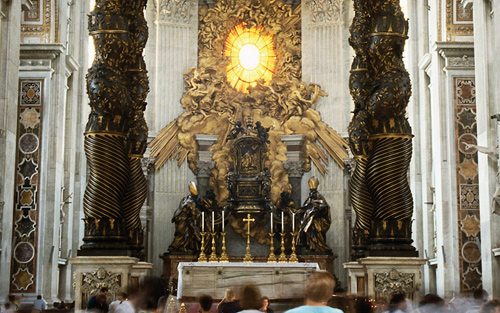
Baldacchino
Whether
you view it as ostentatious or glorious, Bernini’s huge altar canopy is
at least impressive. Its spiralling bronze columns are claimed to have
been made from the revetments (portico ceiling decorations) of the
Pantheon, taken by Pope Urban VIII. For his desecration of the ancient temple the Barberini pope and his family were castigated with the waggish quip: “What even the barbarians wouldn’t do, Barberini did.”

Baldacchino
Treasury
Among
the ecclesiastical treasures here is a 6th-century, jewel-encrusted
bronze cross (the Crux Vaticana), various fragments of the medieval
basilica including a ciborium by Donatello (1432), and Antonio
Pollaiuolo’s masterful bronze slab tomb (1493) for Sixtus IV, the pope’s
effigy surrounded by representations of theological virtues and liberal
arts.Apse
Bernini’s
exuberantly Baroque stained-glass window (1666) centres on a dove
representing the Holy Ghost, surrounded by rays of the sun and a riot of
sculptural details. Beneath the window sits the Chair of St Peter
(1665), another Bernini concoction; inside is a wood and ivory chair
said to be the actual throne of St Peter. Bernini also crafted the
multicoloured marble Monument to Urban VIII (1644) to the right, based
on Michelangelo’s Medici tombs in Florence. It is of far better artistic
quality than Giuglielmo della Porta’s similar one for Pope Paul III
(1549) to the .Crypt
Many
of the medieval basilica’s monuments are housed beneath the basilica’s
floor. During excavations in the 1940s workers discovered in the
Necropolis the legendary Red Wall behind which St Peter was supposedly
buried. The wall was covered with early medieval graffiti invoking the
saint, and a box of bones was found behind it. The late Pope John Paul
II is buried in the crypt.