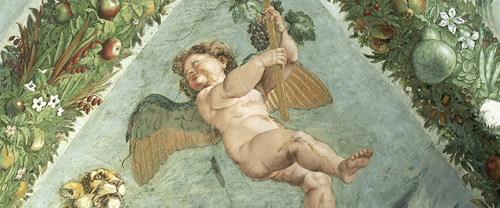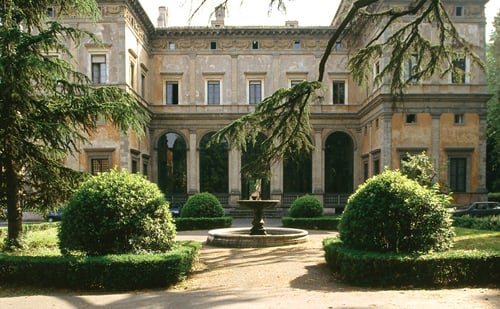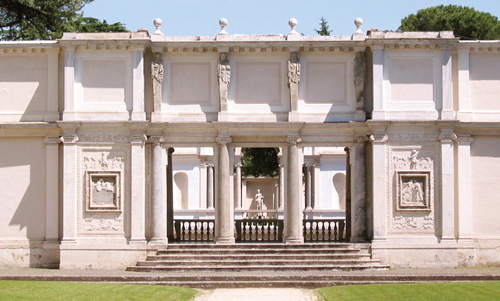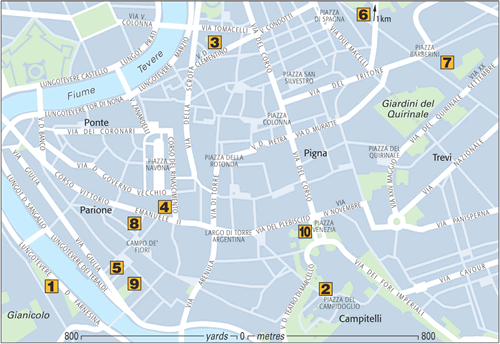
A
little gem of gracious living, decorated by some of the greatest
artists of the Renaissance, including Raphael. The loggias are now
glassed in to protect the precious frescoes, but they were originally
open, embodying the ideal of blending indoor and outdoor spaces – a
concept borrowed from ancient Roman villa designers .

Fresco, Villa Farnesina

Villa Farnesina courtyard
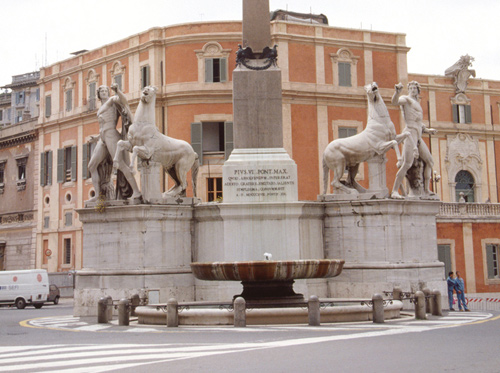
Campidoglio Palazzi
When
Emperor Charles V visited Rome in 1536, Pope Paul III was so
embarrassed at the Capitol’s state that he enlisted Michelangelo’s help.
Work started 10 years later, but Michelangelo died long before its
completion. True to his design, however, are the double flight of steps
for the Palazzo Senatorio, the addition of Palazzo Nuovo, the fine
façades and placement of ancient sculptures.Palazzo Borghese
Called
“the harpsichord” because of its unusual shape, this 17th-century
palace was once the centre of fashionable entertainments for Rome’s
papal high society. Its Mannerist courtyard, in particular, was the
stage for lavish affairs. You can peek in to see the oversize statuary,
columns supporting the double loggias, and the “Bath of Venus” fountain .Palazzo Massimo alle Colonne
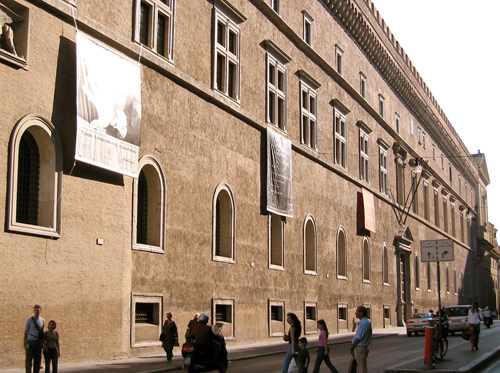
Architect
Peruzzi overcame a number of technical problems to build this
16th-century masterpiece. Primarily, he had to follow the curve of the
foundations of the ancient Theatre of Domitian. His colonnaded portico
is an elegant solution along the street side; the other façade is
decorated with monochrome frescoes, known as grisaille .

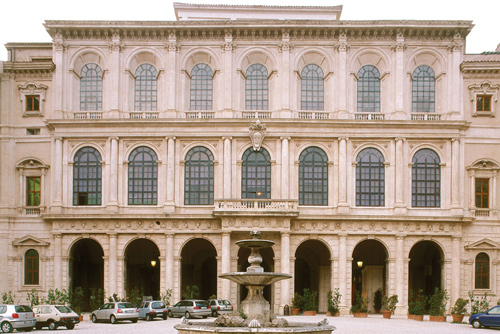
Palazzo Barberini
When
Maffei Barberini became Pope Urban VIII in 1623, he decided to build a
family palace on the (then) edge of town. Architect Carlo Maderno
designed it as an outsize country villa with three floors of arcades.
Bernini added the square staircase on the left; Borromini the spiral
staircase on the right .

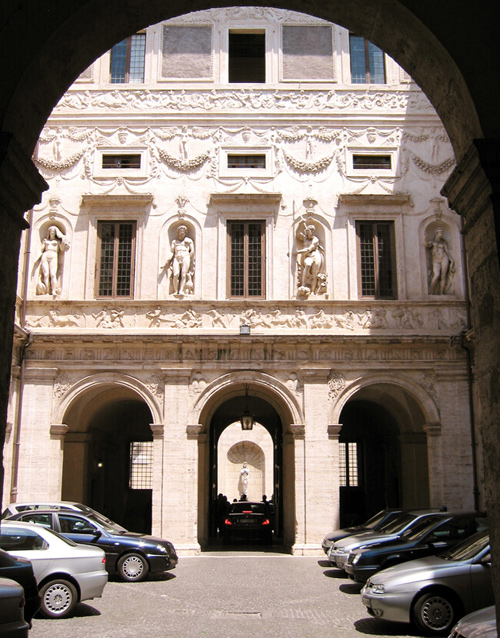
Palazzo Spada
Built
around 1550 for a wealthy cardinal, the architect unknown, this palace
has one of the most ornate Renaissance façades in Rome, featuring
reliefs evoking the city’s glorious past. However, the inner courtyard
is the masterpiece, decorated with stucco figures of the 12 Olympian
gods and goddesses.