As its name suggests, the
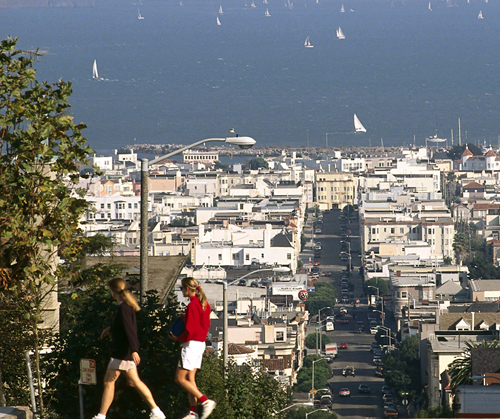
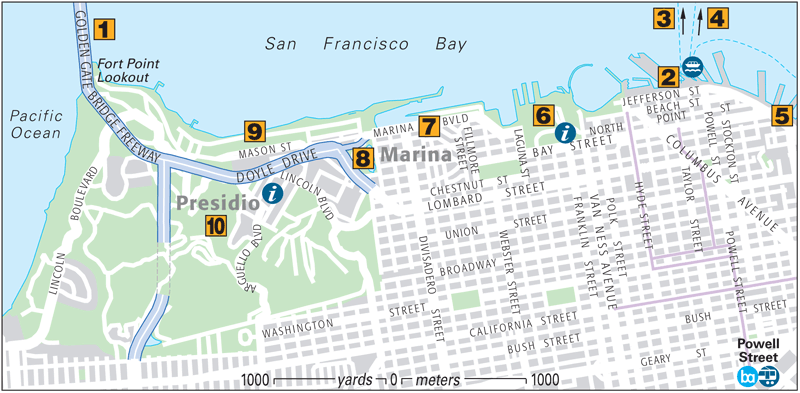
Bayshore area spreads out along the Bay at the northern edge of the
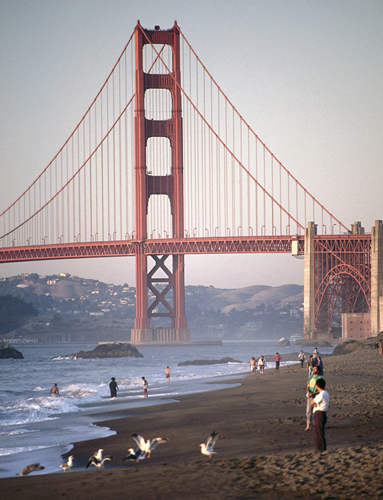
city, faces the islands, and enjoys unforgettable views of both the Bay
and Golden Gate Bridges. Historically, the city began its life here,
when the Spanish set up a military outpost at the Presidio in 1776. More
history can be found at the piers of the northern Embarcadero,
including now heavily commercialized Pier 39 and Fisherman’s Wharf,
where San Francisco’s fishing industry began in the 19th century. But
also part of the area is the smart Marina District, with its swanky
homes and two yacht clubs. Some of the finest parks are found here too,
most notably the Presidio, Crissy Field, the Marina Green, and the Great
Meadow above the Fort Mason Center. A particularly stylish remnant of
the 1915 Panama-Pacific Exposition is also found here – the
Neo-Classical Palace of Fine Arts – with its hands-on science museum
annex, the Exploratorium.
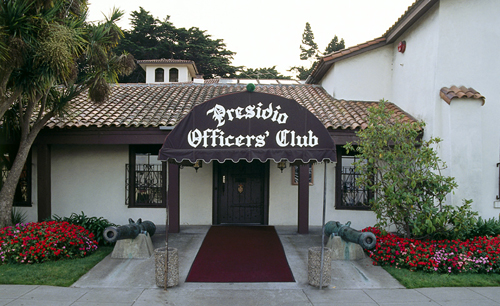
Presidio Officers’ Club, 50 Moraga Ave at Arguello Blvd
.
Sights
Angel, Treasure, and Yerba Buena Islands
A
trip out to Angel Island, now a state park, can make for a very
pleasant day of picnicking, biking, hiking, kayaking, and swimming. But
in the early 1900s it was the “Ellis Island of the West,” where would-be
immigrants, mostly Chinese, could be detained for months. During World
War II, it served as a prisoner of war camp and later as a missile base.
Treasure Island was built in 1939 for the Golden Gate International
Exposition and was a US Navy base during World War II; it is now once
again owned by the city and has recently become San Francisco’s newest
suburb. Yerba Buena Island is a Coast Guard station and is mostly closed
to visitors.Ferries from Pier 41
The Embarcadero
The
Embarcadero starts at Aquatic Park and curves all the way around to
Hunters Point at the southeastern edge of the city. Now that the Port of
Oakland handles the Bay’s shipping needs, the old piers are used for
any number of purposes these days, and the parallel road has recently
become a park promenade .
Pier 39 is the most famous since it was turned into an amusement
attraction in the 1980s, while other piers house concerts, festivals,
antiques fairs, and restaurants. When looking for a particular pier,
note that those to the north of the Ferry Building have odd numbers and
those to the south, even.

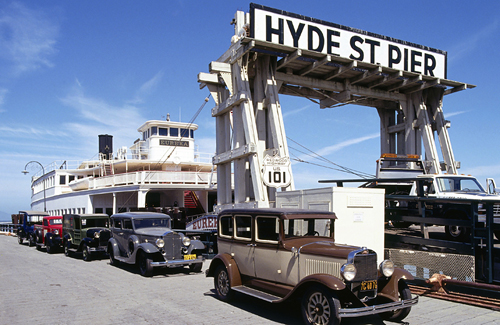
Hyde Street Pier, The Embarcadero

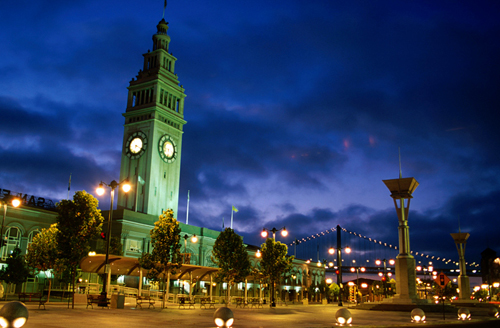
Ferry Building, Embarcadero
Fort Mason Center
Formerly
a military base established during the Civil War, some of the army
buildings have been devoted to cultural programs of all kinds since
1976. Some 50 organizations now call it home, including museums, art
galleries, theaters, shops, festivals, fairs, and performance spaces, as
well as libraries and various institutes. Some of the most prominent
are the Museum of Craft and Folk Art and the Museo ItaloAmericano, the San Francisco African-American Historical and Cultural Society, the Children’s Art Theater, the Magic Theater, and Herbst Pavilion. The city’s finest vegetarian restaurant, Greens, is also located here, enjoying unique views of the Bay and Golden Gate.

Logo, Fort Mason Center
Marina District
This
is a pleasant, upmarket zone, featuring bars and trendy boutiques along
Chestnut Street. Marina Green is a vast lawn where locals love to jog,
skate, fly kites, picnic, or walk their dogs. At the tip of the
breakwater that protects the Marina, you can tune in to the bizarre
sounds of the Wave Organ, an instrumental structure of underwater pipes
through which the tides slosh in a vaguely musical fashion.

View of the Marina District
Palace of Fine Arts and the Exploratorium
The
sole survivor – with a lot of help from restorers – of the many fantasy
monuments built for the 1915 Panama-Pacific Exposition, the
Neo-Classical Palace was an Expo’ centerpiece. The dome of the rotunda
is supported by a Classical frieze and an octagonal arcade, which is set
off by a landscaped lagoon and flanked by an open peristyle of
Corinthian columns .
Behind it is the Exploratorium, one of the world’s first hands-on
science museums. It boasts more than 650 exhibits, divided into 13
subject areas, such as Electricity, Motion, Weather, Vision, Color and
Light, and Sound .3601 Lyon St
415 EXP LORE
general info: 415 561 0360
Open 10am–5pm Tue–Sun
Adm
Crissy Field
Originally
marshland and dunes, the field was filled in for the 1915 Pan-Pacific
Exposition and paved over entirely for use as an airfield by the army
from 1919–36. With the establishment of the Presidio as a national park
under the supervision of the city, a massive restoration project has now
returned part of Crissy Field to wetlands and the rest to lawns,
pathways, and picnic areas. The city’s 100-acre “Front Yard” is one of
the prime viewing sites for the July 4 fireworks displays, while the
Golden Gate Promenade is a 3-mile (5-km) paved pathway that runs through
this district from Aquatic Park to Fort Point.The Presidio
This
beautiful wooded corner of the city has stunning views over the Golden
Gate, but from 1776 until 1994 it was owned and occupied by first the
Spanish, then the Mexican, and finally, the US armies, and almost
entirely off-limits to anyone else. It has now been dubbed a major part
of the Golden Gate National Recreational Area, and plans are still
coalescing as to its ultimate future. At the very least, it is a
spectacular park, full of nature trails, streams, forests, drives, and
historic structures. In 2005 filmmaker George Lucas moved his production
company, LucasFilm, to the Presidio, creating a $350 million headquarters.

Presidio Officers’ Club, The Presidio