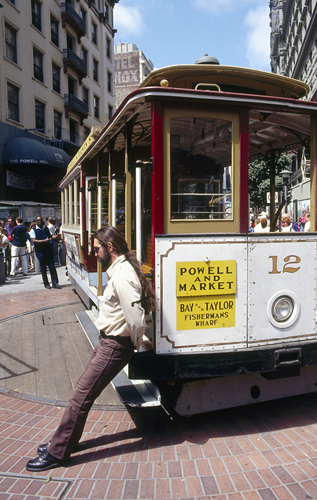
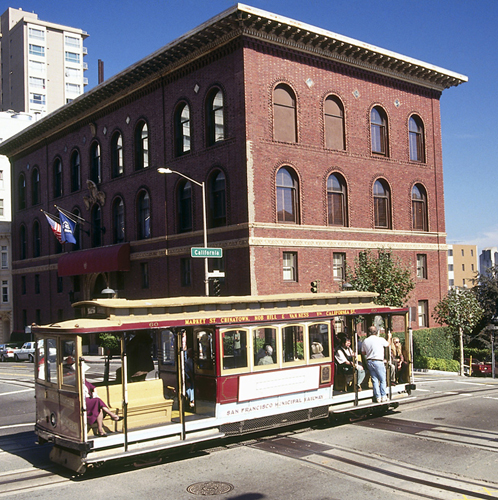
It’s impossible not to love these sturdy little
vestiges of another age, as they valiantly make their merry yet
determined way up the city’s precipitous hills. Yet these San Francisco
icons came perilously close to being completely scrapped in 1947, when a
“progressive” mayor announced it was time for buses to take their
place. An outraged citizenry, under the leadership of “cable car
vigilante” Mrs. Friedell Klussman, eventually prevailed, and the whole
system was declared a National Historic Landmark in 1964. In the early
1980s, the tracks, cables, power plant, and cars all underwent a massive
$60-million overhaul and retrofit. The present service covers some 12
miles (19 km) and utilizes about 40 cars.
Wire rope manufacturer
Andrew Hallidie’s cable car system dates from August 2, 1873, when he
tested his prototype based on mining cars. It was an immediate success
and spawned imitators in more than a dozen cities worldwide. However, 20
years later, the system was set to be replaced by the electric
streetcar. Fortunately, resistance to above-ground wires, corruption in
City Hall, and finally the 1906 earthquake sidetracked those plans. The
cable car was kept for the steepest lines, while the streetcar took over
the longer, flatter routes. |

Cable car route
Rather than wait in the long
lines at a cable car terminus, do what the locals do and walk up a stop
or two, where you can hop on right away – then hold on! |
|
The $5.00 fare is for one
ride, one direction only, and there are no transfers. Consider getting a
CityPass or a Muni Passport for one day ($10) or longer . |
|
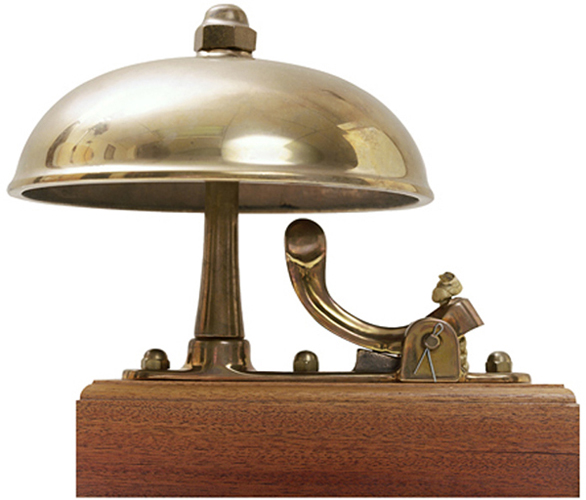
Every grip person develops their own signature ring on the car’s bell, and a ringing contest is held every July in Union Square. |
|
The cables, which cost at least $20,000 each, must be replaced every two to three months due to the terrific wear and tear. |
|
Top 10 Features
Cars
Cable
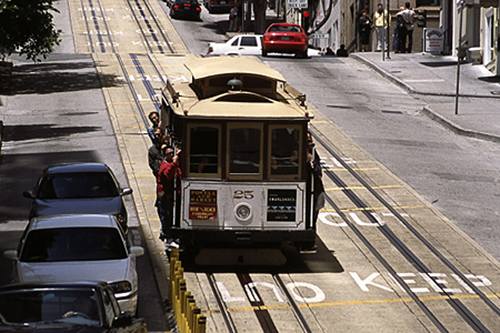
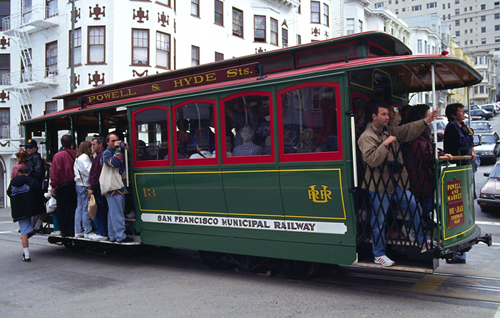
cars come in two types: one with a turnaround system, one without. All
are numbered, have wood and brass fittings in the 19th-century style,
and are often painted in differing colors.
Bell
During
the course of operation up and down the busy hills, the cable car’s
bell is used by the grip person like a claxon, to warn other vehicles
and pedestrians of imminent stops, starts, and turns.

Grip Person
The
grip person must be quick-thinking, and strong to operate the heavy
gripping levers and braking mechanisms. The grip is like a huge pair of
pliers that clamps onto the cable to pull the car along.
Conductor
The
conductor not only collects fares, but also makes sure that everyone
travels safely, and that the grip person has room to do his job.
Cables
The
underground cables are 1.25 inches (3 cm) in diameter and consist of
six steel strands of 19 wires each, wrapped around a rope, which acts as
a shock absorber.
Braking
There
are three braking mechanisms. Wheel brakes press against the wheels;
track brakes press against the tracks when the grip person pulls a
lever; while the emergency brake is a steel wedge forced into the rail
slot.
Cable Car Museum
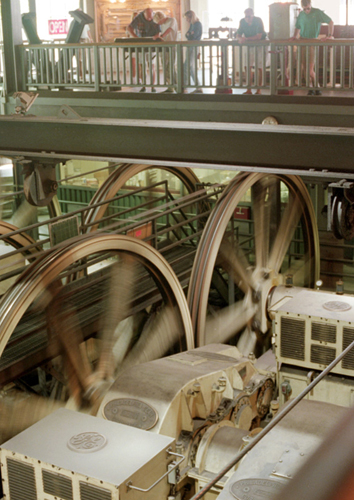
Downstairs,
look at the giant sheaves (wheels), that keep the cables moving
throughout the system; upstairs are displays of the earliest cable cars.

Riding Styles
There
is a choice of sitting inside a glassed-in compartment, sitting on
outside wooden benches, or hanging onto poles and standing on the
running board. The third gives you the sights, sounds, and smells of San
Francisco at their most enticing.

Turntables
Part
of the fun of cable-car lore is being there to watch when the grip
person and conductor turn their car around for the return trip. The best
view is at Powell and Market streets.

Routes
The
three existing routes cover the Financial District, Nob Hill,
Chinatown, North Beach, Russian Hill, and Fisherman’s Wharf areas. As
these are always important destinations for visitors – and for many
residents, too – most people find that a cable car ride will be
practical as well as pleasurable.