As with most of the world’s wonders, many said that
the Golden Gate Bridge could never be built – the span was too wide, the
ocean too powerful and deep, and the cost too great. But to many more,
the Golden Gate, the name John Fremont gave the splendid strait in 1844 ,
demanded the realization of its dream bridge. In 1872, railroad tycoon
Charles Crocker first conceived the idea, but it took a visionary
engineer, Joseph Strauss, to put forth a realistic proposal in 1921.
After 10 years of opposition from all quarters, funding was finally
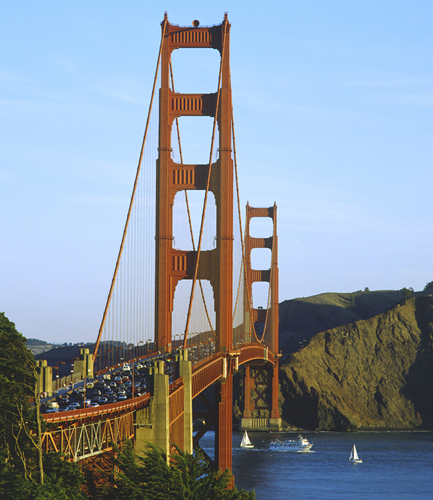
secured from A.P. Giannini, founder of the Bank of America . The bridge opened in 1937, and has been an emblem of San Francisco and America’s icon on the Pacific ever since.
The length of the steel
wires used to make the cables of the bridge is enough to circle the
earth three times. It is also brilliantly “over-engineered” and is said
to be five times stronger than it needs to be to withstand the winds and
tides it endures daily. At the time it was built, it was the longest
suspension bridge in the world (it still ranks seventh) and took just
over four years to build. More than 41 million vehicles cross the bridge
annually, streaming across six lanes of traffic, along its 1.7-mile
(2.7-km) length. The bridge is equipped with two foghorns, each with a
different pitch, and 360-degree flashing red beacons. The bridge has
been closed due to high winds only three times in its history. |


Marin Vista Point
For a uniquely powerful view of
the bridge while enjoying a Sunday champagne brunch, opt for one of the
many cruises on the Bay, departing from the Embarcadero Pier and
Sausalito. Excellent purveyors are Signature Yacht Events (415 788 9100,
www.signaturesf.com), and Seaward (415 331 3214, www.callofthesea.org). |
|
The orange color was
actually the original rust-proof undercoat, but it complements the
natural setting so well that it was kept. |
|
Pedestrians may access the east sidewalk 5am–9pm daily. In-line skaters and skateboards are not allowed. |
|
Top 10 Features
Deco Style
The
bridge owes its striking style to the consulting architects Irving F.
Morrow and his wife Gertrude. They simplified the pedestrian railings to
uniform posts placed far enough apart to allow an unobstructed view.
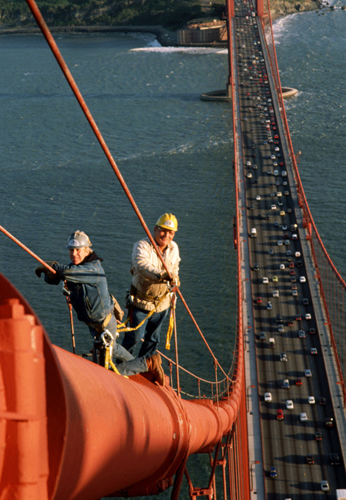
Maintenance
Repairing
and painting the bridge is an ongoing task. The paint protects it from
the high salt content in the air, which corrodes the steel components.

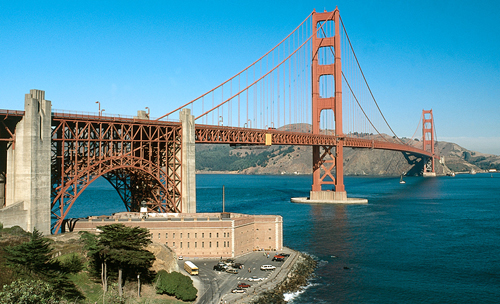
Fort Point Lookout
On
the city side stands an 1861 fort. This spot provides a view of the
soaring underside of the structure and the pounding waters of the ocean.

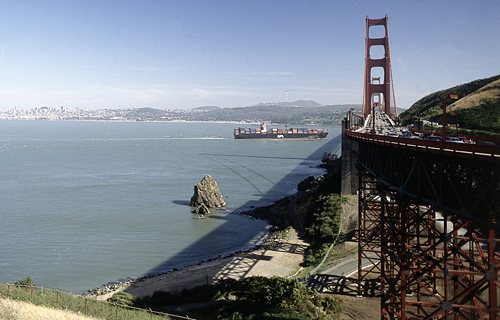
Marin Vista Point
Crossing
from the San Francisco side, pull off just before you reach the end of
the bridge and take in the startling panorama from the specially
constructed Vista Point and look back at the hills and spires of the
city. If there’s fog, note how the bridge’s tower tops disappear in the
mist.
Star Turns in Movies
The bridge has starred in many movies, most notably Alfred Hitchcock’s Vertigo, in which James Stewart pulls Kim Novak from the raging surf, just east of Fort Point .
In the James Bond movie, A View To A Kill, Grace Jones and 007 battle
it out, both of them clinging to the bridge’s aerial heights.
Protective Barriers
The
Golden Gate Bridge is the number one spot in the world for suicides. As
yet there are no effective preventative barriers but there are bars for
general safety.
Building the Bridge
Joseph
Strauss introduced the use of hard hats, goggles, and safety belts for
the first time, as well as a vast safety net under the bridge, which
saved 19 workers.
Bridge Celebrations
The
bridge opened on May 28, 1937, with some 200,000 pedestrians. Fifty
years later, on May 24, 1987, the ritual was repeated with about 300,000
people.
Hiking and Biking
No visit to San Francisco would be complete without a walk or bike-ride across at least part of the bridge.
Toll System
Beginning
May 28, 1937, the toll to cross the bridge was 50 cents each way, with a
5-cent charge if a car had more than three passengers. The toll is
currently $5 per vehicle, only charged to city-bound traffic.