NOTE
Your toddler has lost his privileged position as your only child—it’s no wonder he’s out of sorts
Here comes baby Preparing for a new arrival
A new baby brings
great pleasure and real upheaval—not only for parents but for older
children, too. Your toddler’s world will change. He’ll need to share
your attention and may have to wait while the new baby is seen to first.
Explaining to him that he’ll be sharing his home, and your time and
attention with another child can be a challenge which needs thoughtful
and sensitive handling.
Your child’s feelings
Developmentally, your young
child will find it very difficult to see things from someone else’s
perspective. As far as he is concerned, he is the very center of the
universe, and he may not understand why you would want another child. He
may even be concerned that you are going to replace him with your new
baby! If your toddler is feeling anxious, you may find that he is more
clingy and upset, or has more temper tantrums than usual. Continue to
manage his behavior as before: It is important to maintain consistency
as this will be reassuring for him.
Pregnancy and delivery
Your child
will have a very limited understanding of time, so think carefully about
when you are going to tell him that you are having another baby. Too
early and you will be answering questions for a very long time; too late
and your child will pick up on the fact that something is different and
may feel left out and insecure. Linking the birth to a significant
event around the time, such as a birthday, can help your child to
understand when their sibling will be arriving. Taking your child to
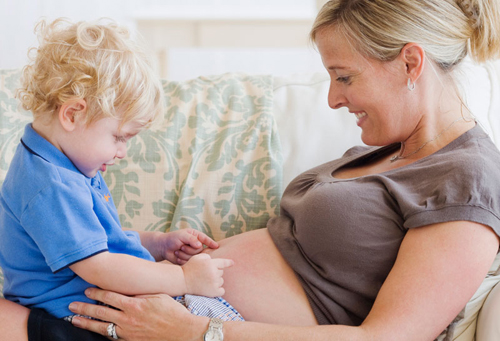
prenatal appointments so he can listen to the baby’s heartbeat, allowing
him to stroke and talk to your belly, and feeling the baby kick will
make him feel included, making the pregnancy more real to him. Many
children’s books tell the tale of a new baby coming into the family.
Reading these stories together will help his understanding and prompt
questions about how life is going to be.
If you are having a
hospital birth, it can be helpful to explain a little about what will
happen as children tend to associate the hospital with sickness, and may
worry about you.
Dealing with changes at home
Include your child
in preparing your home so he does not feel the baby is pushing him out.
For example, he could help with choosing equipment, clothing, and room
colors. If you are going to allow your child to help out in this way,
make sure that you give him a limited range of options to choose from.
Your child may be
excited at the prospect of having someone new to play with and may not
understand that, initially, his sibling will be unable to run around and
have fun with him, and will actually be a rather noisy addition to the
household. Show him photos and videos of himself at that age to help him
to be more realistic in his expectations.
What’s in there?
Involve your child in your new baby’s life by allowing him to talk to your belly.
Jealous toddler A common reaction to a new birth
Your toddler has to cope
with a big change—the entrance of a rival for your affection. Not all
toddlers are jealous of their new sibling, and most react positively, at
least in the early days. At first your toddler is likely to be
fascinated by the baby, want to touch and stare at her, be eager to
choose a gift, and proudly introduce “his” baby to everyone who visits.
Jealousy emerges
For some
toddlers, this initial goodwill turns to jealousy as the excitement of
birth gives way to everyday routine, and he realizes he gets less of
your attention and that his sister isn’t yet the playmate he wanted.
Many toddlers think the baby is a temporary visitor and, once she
leaves, everything will go back to normal. Discovering the change is
permanent can trigger his negative reaction. Having been first in line
for your time, now he’s often at the end, as the baby’s cries are
attended to first. It’s no wonder he’s a little out of sorts.
You may find your
toddler shows only a mild reaction, perhaps regressing to wanting his
pacifier, increasing his thumb sucking, having worse separation anxiety,
or wanting to be by your side rather than play independently. This can
be remedied by plenty of loving reassurance that he’s still important to
you. It is essential that he still have one-on-one time with you every
day, even though this can be difficult to achieve. A few minutes of
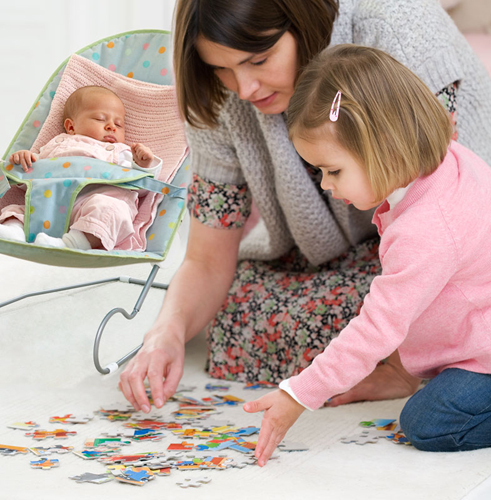
games on the carpet when the baby is in her bouncy-seat and some quiet
cuddle time before bed, perhaps sharing a story just like you used to,
will reassure him that your feelings for him haven’t changed. Where
possible, keep to the same outings and activities as before. This
reassures him that he’s not going to miss out on playgroup or visiting
friends because of the new arrival. He’ll feel more settled when some
things in his life stay the same.
A strong reaction?
A small number of
toddlers react strongly to the new arrival and show their anger at being
displaced through tantrums, trying to hurt the baby, and saying things
like “I wish the baby was dead” or “I hate the baby.” These reactions
can be very distressing as you naturally want him to love his sibling,
and you may be shocked at the strength of his emotions. Be reassured
that his harsh words are “in the moment” expressions of anger, and he
may well be loving toward the baby within minutes of an outburst. No
matter whether your toddler is delighted or unhappy about the new
arrival, he should not be left alone with the baby. Close supervision is
especially important if he is angry or jealous, because he’s not able
to judge how dangerous it could be if he hit or pushed the baby or
covered her face, and he may cause her serious harm. When it comes to
his angry words, avoid lecturing him or showing how upset you are. It is
preferable if you acknowledge his emotion and leave it at that, for
example saying, “You seem angry with the baby” or “I can tell you’re not
happy with the baby right now.” This is an important sign to him that
you still notice and recognize his feelings.
His jealousy can be toned
down if you give him the role of your assistant. Give him a doll to
care for so he can copy you as you bathe and tend to the baby. Role
playing the behavior of adults is a favorite activity for young children
and allows him to express his feelings through play rather than
directly at his sibling. Work out a plan for times when you have to give
the baby lots of attention and can’t respond easily to demands from
your toddler. If you set up your older child with a snack or game it can
give you those precious few minutes to settle or feed the baby, and
keep your toddler satisfied too.
Mommy’s little helper
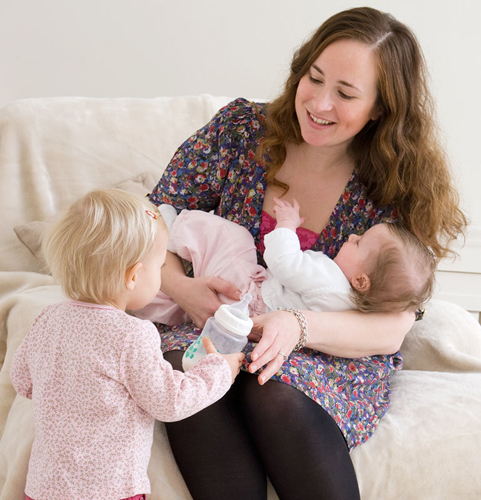
Passing the diaper or fetching a towel or bottle can make your older child feel useful and important, reducing her jealousy.
All together now
Take the time to play with your toddler when the new baby is present, but not in need of your direct attention.