When Abigail Adams arrived in
Washington in 1800, she described Georgetown as “the very dirtiest hole
I ever saw.” Then a major port with a huge slave and tobacco trade,
cheap housing, and commercial wharves, the town may have been
unattractive. But the Chesapeake and Ohio Canal and its competitor, the
Baltimore and Ohio Railroad, brought prosperity to Georgetown, and
therefore style. When the canal began to fail after flood damage, slum
conditions returned, until Franklin D. Roosevelt partly rehabilitated
the area. Its current modish position stems from the Kennedy era, when
Georgetown became fashionable.
Sights
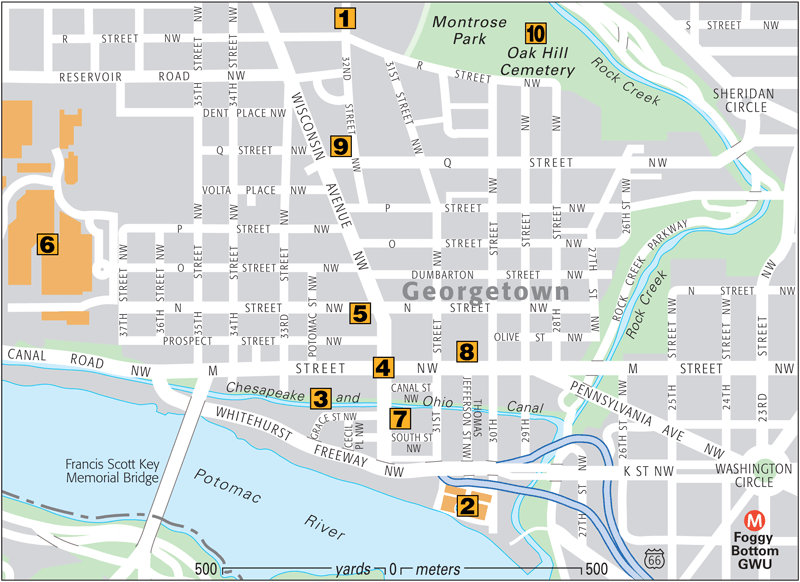
Dumbarton Oaks Museum and Gardens
This
elegant Federal-style house, with its Philip Johnson-designed wing,
houses a world-renowned collection of Byzantine and pre-Columbian
artifacts. El Greco’s Visitation
is here also, possibly the Spanish master’s last painting. The house
and museum are surrounded by acres of gorgeous landscaping .1703 32nd St, NW
Open 2–5pm Tue–Sun
Adm
Washington Harbor
Dockside
cafés, good restaurants, lovely views of the Potomac and the Kennedy
Center, the Watergate complex, and the Thompson boathouse, walkways for
strolling, and benches for resting make the harbor a magnet for
Georgetowners on warm evenings. The Washington Harbor residential and
commercial building is an architectural exuberance designed by Arthur
Cotton Moore and Associates.Chesapeake and Ohio Canal
Like
so many features of the area, the C&O Canal grew from a dream of
George Washington’s as a gateway to commerce with the US lands to the
west (“west” meaning Ohio at the time). Coal, flour, fur, timber,
whiskey, iron ore, and other goods traveled on barges, towed by mules
walking along canalside paths. The canal’s commercial days are over, but
its entire length from Georgetown to Maryland has been turned into one
of the most beloved national parks. Visitors˙ can experience the beauty
and serenity of the canal by walking about a block south from M Street,
NW and turning west onto the towpath. The National Park Service Visitor
Center for the C&O has terrific guidance for enjoying the canal.
Guided tours and seasonal mule-powered barge rides are offered .Visitor Center
1057 Thomas Jefferson St, NW
202 653 5190
Open 9am–4:30pm Wed–Sun; closed winter

Rowhouses, C&O Canal
M Street and Wisconsin Avenue
This
intersection is surrounded by the main shopping, entertainment, dining,
and bar-crawling areas of Georgetown. The attractive shops of Georgetown Park
include hundreds of retailers selling cool urban clothes, jewelry, fine
wine, art and antiques, and countless other specialties. Restaurant
food of every description is available, from modern gourmet to street
window kebabs.

M Street
Elegant Georgetown House
N Street
Little
attractions and oddities abound on this street, which is noted for its
exemplary architecture. Best seen from the sidewalk on 28th Street, NW,
the house at No. 2726 has an outstanding mosaic by Marc Chagall, a
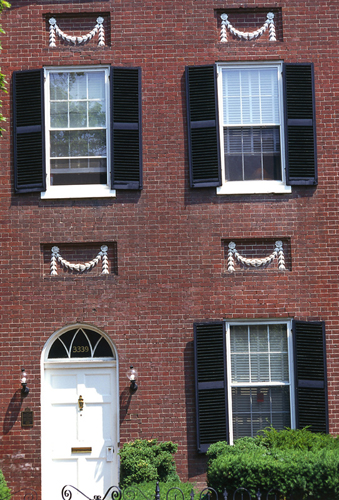
friend of the former owner. The elegant Federal house at No. 3038 was
home to Ambassador Averill Harriman, who lent the house to Jacqueline
Kennedy after her husband’s assassination. She later bought the
elaborate 1794 Thomas Beall house across the street. Lessons in
19th-century architecture can be learned from the Federal houses at Nos.
3327 and 3339, the Second-Empire home at No. 3025–7, and the Victorian
homes of Wheatley Row at Nos. 3041–45.
N Street house
Georgetown University
This
venerable institution sits on its hill overlooking Georgetown and the
Potomac like a medieval citadel, its stone towers seemingly brooding
with age. Yet the university is one of the most progressive in the
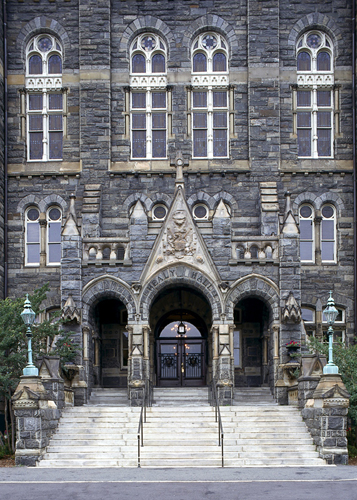
country. Among the many interesting buildings here is the 1875 Healy
Hall, built in an elaborate Flemish Renaissance style with surprising
spiral adornment. Visitors can obtain campus maps and suggestions for
strolls from the booth at the main gates.Gatehouse visitors booth
O & 37th Sts, NW
Call for details: 202 687 0100

Georgetown University
Grace Church
The
1866 church construction was built to house a congregation founded to
serve the boatmen and support staff of the C&O Canal. The simple but
extremely elegant design brings back the mid-19th century, although
admittedly without the raucous bustle that must have accompanied the
canal at its peak. The grounds are beautifully peaceful. The church
offers poetry readings, theater performances, and concerts. Today’s
congregation has a serious devotion to community service and outreach.1041 Wisconsin Ave, NW (one block south of M St)
Open by appt
(tel: 202 333 7100)
Office
Open 10am–6pm Mon, Tue, & Fri
Free
Old Stone House
This
remarkable residence dating from 1766 looks a little incongruous
standing directly in the heart of the shopping area, but it provides a
captivating window into 18th-century life. The National Park Service
provides tours and fascinating demonstrations of the crafts and tasks of
colonial families.3051 M St
Open Jan–Mar: noon–5pm daily; Apr–Dec: 11am–5pm daily
Dis. access
Free
Tudor Place
This
house museum would be remarkable for its beauty even without its
historic interest. Completed in 1816, the house was built by Thomas
Peter, son of a Georgetown tobacco merchant, and Martha Custis Peter,
granddaughter of Martha Washington. The Peter family occupied the house
for six generations and played hosts to many prominent guests.1644 31st St, NW
202 965 0400
Open 10am–4pm Tue–Sat, noon–4pm Sun; closed Jan, federal holidays
Dis. access
Adm

Tudor Place