This fascinating museum’s 22 main exhibition
galleries pay homage to some of the most ingenious and beautifully
crafted objects of flight, from the Wright brothers’ airplane to
powerful spacecraft. America by Air outlines the history of America’s
airline industry including airplanes from the formative years of
mechanical flight. Compelling exhibitions put these historic objects in
their social and political context. Moon rock is displayed so that the
public can touch it.
-
Independence Ave, SW & 7th St, SW
-
202 633 1000
-
www.nasm.si.edu
-
Open 10am–5:30pm daily; closed Dec 25
-
Dis. access
Steven F. Udvar-Hazy Center
|
|
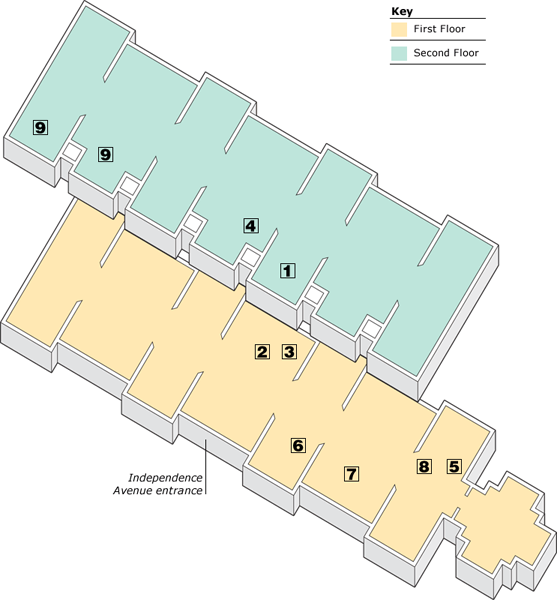
Entrances to the museum
are on both Independence Avenue and the Mall. Both lead into the
spacious central hall where the most famous airplanes of all time are
displayed. An information booth is near the Independence Avenue
entrance. Visitors who plan to enjoy a film at the Lockheed Martin IMAX
Theater or the Albert Einstein Planetarium should obtain their tickets
on arrival at the museum, since seats are often not available
immediately.
|
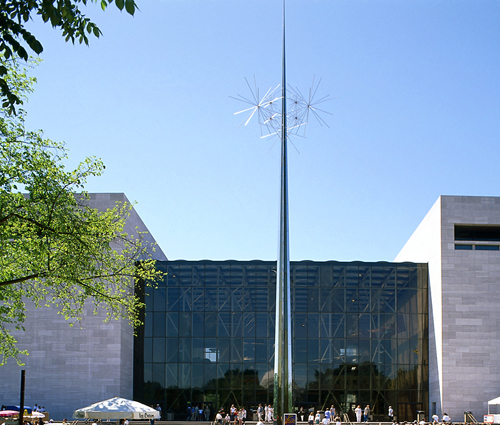
Museum façade
|
McDonald’s, Boston Market, and Donato’s Pizzeria are located in the greenhouse-like extension on the east end of the building.
|
|
|
The gift shop displays the model of the USS Enterprise used in the filming of Star Trek. This is the largest of the Smithsonian shops and worth a visit .
|
|
Top 10 Exhibits
-
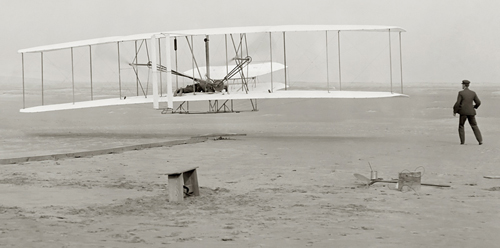
1903 Wright Flyer
On
December 17, 1903, Orville Wright flew this craft 120 ft (35 m), making
it the first plane to be airborne. Muslin fitted with a spruce and ash
framework provided a light but strong body. The Wright brothers also
designed the engine.
-
Ryan NYP Spirit of St. Louis
Charles
A. Lindbergh flew this plane on the first transatlantic flight, 3,610
miles (5,810 km) from Long Island to Paris in 1927. His 33-hour solo
flight made him one of the most famous men of his age and turned
aviation into a public craze. NYP stands for New York–Paris.
-
Apollo 11 Command Module Columbia
This
vessel was the command center for the first human landing in space. It
carried Neil Armstrong, Michael Collins, and “Buzz” Aldrin to the moon
and back.
-
Amelia Earhart’s Lockheed 5B Vega
In
this striking airplane, Amelia Earhart completed the second solo
nonstop flight across the Atlantic, from New-foundland to Ireland in14
hours, 54 minutes.
-
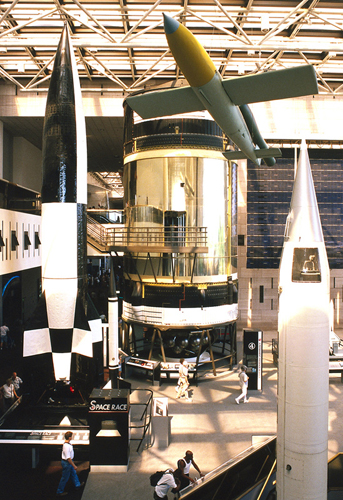
Skylab Orbital Workshop
This
gold cylinder was an identical backup to the workshop that provided
living and research space for the first US space station.
-
How Things Fly
Hands-on
exhibits here lead visitors through the basics of flight, both human
and animal, and explain forces that control flight of all types, from a
helium balloon to a mission to Mars.
-
Looking at Earth
The
focus here is on the contribution aerial photography and space flight
have given to our understanding of Earth. Also memorable is the
breathtaking beauty of some of the images.
-
Re-enactment of the Eagle Moon Landing
Much of the world held its breath on July 20, 1969, as Neil Armstrong and “Buzz” Aldrin and the Lunar Module Eagle
approached and touched down on the moon’s Sea of Tranquillity. Visitors
can re-experience one of the 20th century’s most thrilling moments in
this multimedia display.
-
WWI and WWII Aviation
A
collection of Allied and Axis planes from World Wars I and II, such as
the Messerschmitt Bf 109 and the Supermarine Spitfire, makes this one of
the most popular parts of the museum.
-
Steven F. Udvar-Hazy Center
This
state-of-the-art aviation area near Washington Dulles International
Airport consists of two exhibition hangars. Opened to celebrate the
100th anniversary of the Wright brothers’ first powered flight, it
allows NASM to display nearly 300 aircraft and spacecraft.