Possibly the most famous residential landmark in the
world, this dramatic Neo-Classical mansion has been the residence of the
US president and family, the seat of executive power, and a working
office building for over 200 years. Situated at the nation’s most
recognizable address, 1600 Pennsylvania Avenue, the White House reflects
the power of the presidency. Its 132 rooms preserve and display the
cultural settings of America’s past and present. Lafayette Park to the
north and the Ellipse to the south are popular sites for viewing this
American icon.
|
George Washington
personally supervised the design and construction of the White House,
although he never lived here. John and Abigail Adams became its first
residents in 1800. At the same time, the seat of government was moved
from Philadelphia to Washington, D.C. After the British burned the White
House in 1814, it became the responsibility of the James Monroe
presidency to redecorate. Much of what is seen today reflects Monroe’s
taste.
|
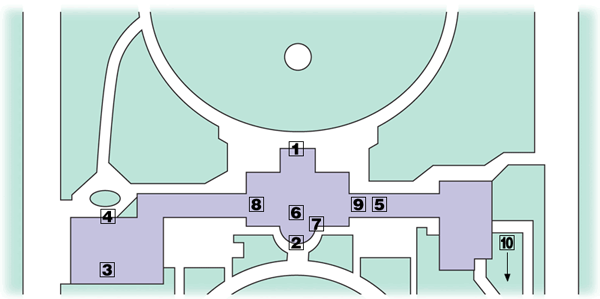
Plan of the White House
|
If you have a
telephoto lens or binoculars, the carved floral decorations on the north
entrance and the plantings of the Rose Garden, viewed from the Ellipse,
deserve attention.
|
|
| |
The White House has
no public restrooms. The nearest facilities are at the Visitor Center
and the Ellipse Visitor Pavilion, near 15th and E streets NW.
|
|
Top 10 Features
-
North Façade
The
stately but welcoming main entrance on Pennsylvania Avenue has a
beautifully proportioned Ionic portico, added in 1829. Painted Virginia
sandstone gives the building its white luster.
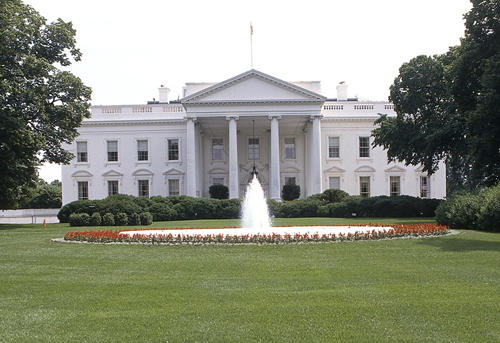
North façade
-
South Façade
The
large semicircular portico added in 1824 dominates the south view. The
six main columns create an optical illusion, appearing to stretch from
ground to roofline, emphasizing the classical proportions.
-
Oval Office
This
illustrious room is the setting for the president’s core tasks. Each
leader adds his own touches – George W Bush decorated it with paintings
of his native Texas by Texan artists.
-
West Wing
This wing is the executive operational center of the White House, moved here in 1902 to allow more privacy in the main building.
-
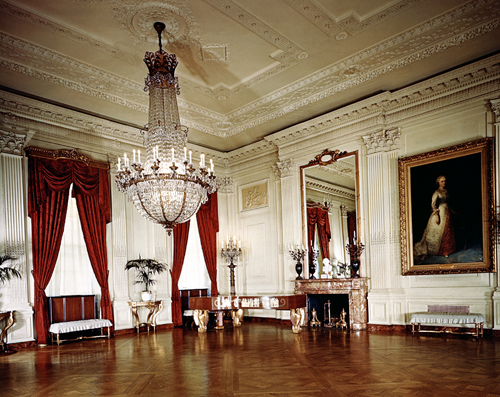
East Room
The
East Room has been used chiefly for large entertainment or ceremonial
gatherings, such as dances, award presentations, press conferences, and
historic bill signings.
-
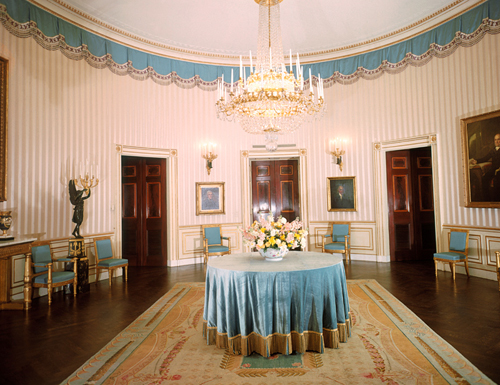
Blue Room
The Blue Room is the most elegant of all the reception rooms – it was George Washington who suggested its oval shape.
-
Map Room
Graceful
Chippendale furniture features in this private meeting room. Franklin
D. Roosevelt adapted it as his situation room to assess the progress of
World War II.
-
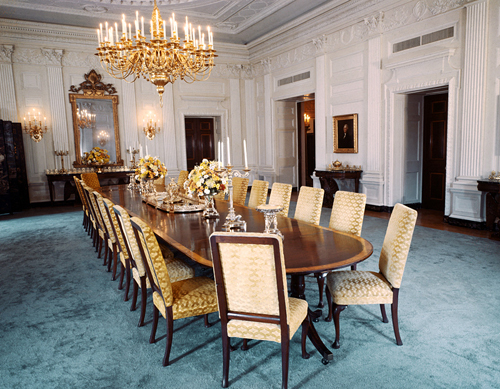
State Dining Room
As many as 140 guests may enjoy the president’s hospitality in this formal dining room.
-
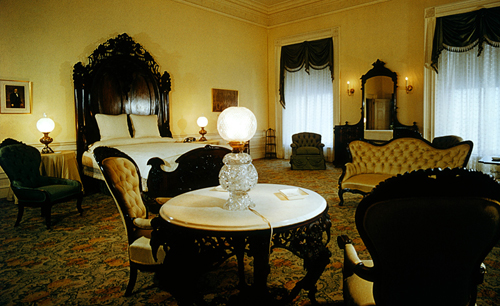
Lincoln Bedroom
Although
the name for this room is a misnomer – Abraham Lincoln used it as an
office – a number of his possessions can be found here. Mary Todd
Lincoln bought the imposing Victorian bed, made of carved rosewood, in
1861.
-
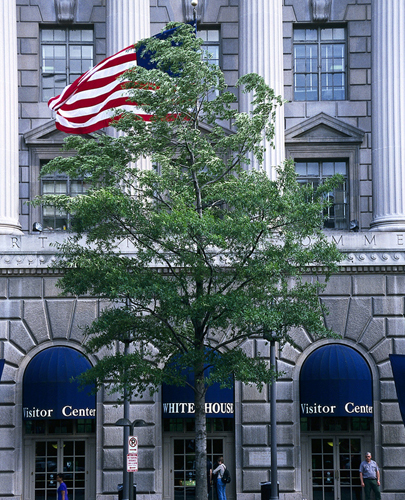
Visitor Center
The
White House Visitor Center has engrossing exhibits on various aspects
of the mansion. It also offers park ranger talks, a souvenir shop, and
special events such as military band concerts.
White House Decorative Features
-
The Vermeil Room
“Vermeil”
refers to the collection of gilded objects by early 19th-century
silversmiths on display. Delightful portraits of seven First Ladies
adorn the walls, and the room is grounded by an exquisite Empire-style
mahogany table in the center.
-
China Room Collection
The
White House collection of china services had grown so large by 1917
that Mrs. Woodrow Wilson set aside a special room in which to display
it. State and family china belonging to nearly every US president fills
the fine display cabinets.
-
Grand Staircase
Descending
gracefully to the Central Hall on the north side, the Grand Staircase
is used for ceremonial entrances to state events in the East Room.
Portraits of 20th-century presidents line the stairwell.
-
Library
This
former storage room was turned into a library in 1935, and contains a
collection of books intended to reflect the philosophical and practical
aspects of the presidency. The furniture is attributed to the
cabinetmaker Duncan Phyfe.
-
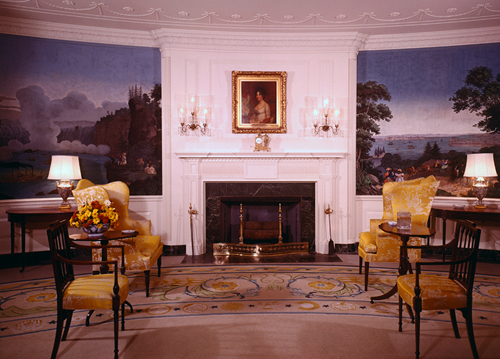
Diplomatic Reception Room Wallpaper
The panoramic wallpaper in this room is a series of large “Views of North America” printed in 1834.
Diplomatic Reception Room
-
Lighter Relieving a Steamboat Aground
This 1847 painting in the Green Room, by George Caleb Bingham, conveys the vitality of the nation.
-
Sand Dunes at Sunset, Atlantic City
This beach landscape (c.1885) by Henry Ossawa Tanner was the first work by an African-American to be hung in the White House.
-
North Entrance Carvings
Scottish stonemasons created the carved surround for the north doorway with flowing garlands of roses and acorns.
-
Monroe Plateau
James
Monroe brought a gilt table service from France in 1817. The plateau
centerpiece is an impressive 14.5 ft (4.5 m) long when fully extended.
-
Seymour Tall-Case Clock
This Oval Office clock ticks so loudly that its pendulum must be stopped when television broadcasts originate from the room.
President Truman’s Renovations
From the time Harry S.
Truman moved into the White House, he had noticed signs that the
building was under a great deal of stress: “The floors pop and the
drapes move back and forth,” and “[t]he damned place is haunted, sure as
shootin’.” In 1948, after some investigation, engineers confirmed that
it was structural weakness, not ghosts, that was causing the problems.
Some people said the house was standing “only from force of habit.” The
only certain solution was to move the Truman family to nearby Blair
House and completely rebuild the White House within its external walls.
Contractors gutted the inside of the building in its entirety – every
floor, wall, ceiling, closet, pipe, wire, and fixture came out. Workers
then built a steel frame, similar to those found in large office
buildings, inside the remaining shell. Within the frame, the White House
was recreated, room by room, from scratch, but in keeping with the
original design. Everything structural that can be seen today in the
house was built between 1948 and 1952. America’s three major networks
broadcast the first-ever television tour of the residence in 1952.
President Truman himself proudly led the tour and even entertained
viewers by playing a tune on one of the pianos in the East Room. A decade later, that arbiter of style Jacqueline Kennedy again restored many of the period features.
Top 10 Events in The White House’s History
-
George Washington supervises construction (1792)
-
John and Abigail Adams move in (1800)
-
The Lewis and Clark expedition to the Northwest is planned (1803)
-
The British burn the White House (1814)
-
James Monroe moves into the partially rebuilt residence (1817)
-
The Executive Mansion is renamed the “White House” (1901)
-
President Roosevelt’s World War II “Fireside Chats” inform and inspire Americans
-
Jackie Kennedy restores the house (1961–2)
-
Nixon announces his resignation (Aug 8, 1974)
-
“In Performance at the White House” broadens its cultural role (1980s)